

Carbon Markets: from ground to green
Key Points
Performance, Quality and Reliability
Phone Number
1800 418 515
History of the Carbon Market
The Australian Carbon Market was established with the introduction of the Carbon Credits (Carbon Farming Initiative) Act 2011 (CFI Act 2011). As part of Australia’s commitment to addressing climate change, this voluntary carbon offsets scheme provides financial incentives for landholders to alter management strategies to store carbon or reduce greenhouse gas emissions.
The CFI Act was amended to include the Emission Reduction Fund (ERF) and the Safeguard Mechanism (CFI Act Amended 2014).
For interests of space, only land sector methods are shown.
Agriculture
- Destruction of methane generated from manure in piggeries (2012) (closed)
- Destruction of methane generated from dairy manure in covered anaerobic ponds (2012) (closed)
Vegetation
- Quantifying carbon sequestration by permanent environmental plantings of native species using the CFI reforestation modelling tool (2012) (closed)
Savanna burning
- Reduction of greenhouse gas emissions through early dry season savanna burning 1.0 (2012) (closed)
Agriculture
- Destruction of methane generated from manure in piggeries V1.1 (2013) (closed)
- Destruction of methane from piggeries using engineered biodigesters (2013) (closed)
- Reducing greenhouse gas emissions by feeding dietary additives to milking cows (2013) (closed / expired)
Vegetation
- Human‑induced regeneration of a permanent even‑aged native forest 1.0 (2013) (closed / revoked)
- Human‑induced regeneration of a permanent even‑aged native forest 1.1 (2013) (closed / revoked)
- Quantifying carbon sequestration by permanent mallee plantings using the reforestation modelling tool (2013) (closed / revoked)
- Reforestation and afforestation 1.1; 1.2 (2013) (closed / revoked)
- Native forest from managed regrowth (2013) (closed / expired)
- Avoided deforestation (2013) (closed / revoked)
Savanna burning
- Reduction of greenhouse gas emissions through early dry season savanna burning 1.1 (2013) (closed / revoked)
The Carbon Credits (Carbon Farming Initiative) Act is integrated with the Emissions Reduction Fund, and amended to include the Safeguard Mechanism.
Agriculture
- Reducing greenhouse gas emissions by feeding nitrates to beef cattle (2014) (closed / expired)
- Sequestering carbon in soils in grazing systems method (2014) (closed / revoked)
Vegetation
- Measurement-based methods of new farm forestry plantations (2014) (closed / revoked)
- Reforestation by environmental or mallee plantings – FullCAM (2014) (closed / revoked)
COP 21 is held in Paris on the 12 December 2015. 195 Parties sign the Paris Agreement, committing to keeping the rise in mean global temperature to well below 2°C and optimally below 1.5°C above pre-industrial levels.
Agriculture
- Beef cattle herd management (2015) — Method expired September 2025 (sunsetting)
- Reducing greenhouse gas emissions from fertiliser in irrigated cotton (2015) (closed / expired)
- Estimating sequestration of carbon in soil using default values (2015) (closed / revoked)
Vegetation
- Avoided clearing of native regrowth (2015) (closed / revoked)
- Avoided deforestation 1.1 (2015) (closed / revoked)
- Reforestation and afforestation 2.0 (2015) (closed / revoked)
- Designated verified carbon standard projects (2015) (closed / revoked)
Savanna fire
- Emissions abatement through savanna fire management (2015) (closed / revoked)
Agriculture
- Measurement of soil carbon sequestration in agricultural systems method (2018) (closed / revoked)
Savanna fire
- Savanna fire management – emissions avoidance (2018) (under review / not currently active)
- Savanna fire management – sequestration & emissions avoidance (2018) (under review / not currently active)
Agriculture / Waste & Methane
- Animal effluent management (2019) — Active (in force) as of Nov
2025
Agriculture / Soil carbon
- Estimation of soil organic carbon sequestration using measurement and models (2021) — Active (in force) as of Nov 2025
Vegetation
- Plantation forestry (2022)
- Tidal restoration of blue carbon ecosystems (2022)
- Environmental plantings pilot (2022
Vegetation / Forestry / Blue Carbon
- Plantation forestry (2022) — Active (in force) as of Nov 2025.
- Tidal restoration of blue carbon ecosystems (2022) — Active (in force) as of Nov 2025.
- Environmental plantings pilot (2022) — Active (in force) as part of current vegetation methods.
- Emissions Reduction Assurance Committee (ERAC) continues to review and propose method changes, revocations, and new methods.
- New method proposals under development (as of 2025) — for example, expanded soil‑carbon methods, waste/biomethane methods, and modifications to savanna fire‑management methods.
- Amongst Agriculture and Vegetation sector, existing “Active” methods like Animal effluent management (2019), Estimating soil organic carbon sequestration (2021), Plantation forestry (2022), Blue carbon + Environmental plantings (2022) remain valid for new project registration as of late 2025.
The Process
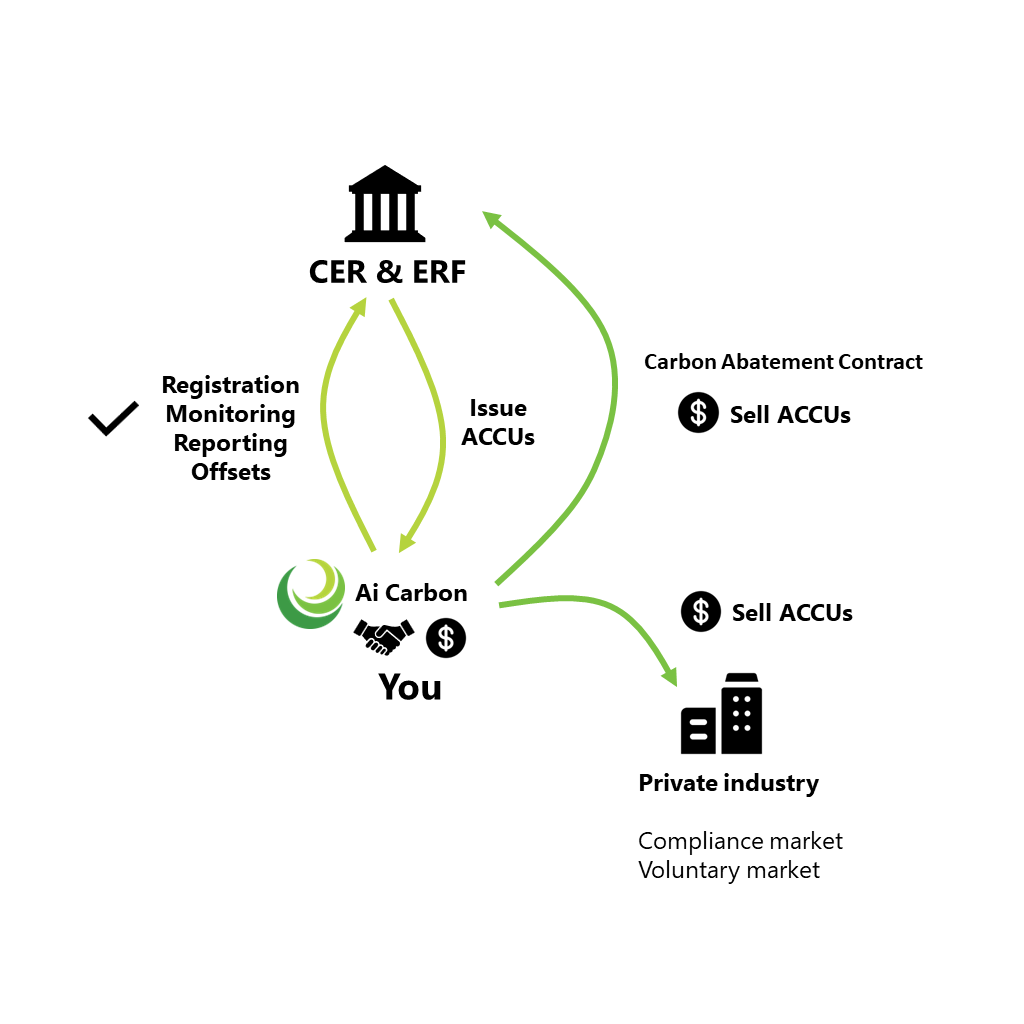
We work with you to conduct a prefeasibility assessment – then if you’re keen – we register a project on your behalf with the CER. Under a management plan developed together that allows for your grazing needs, vegetation begins to regenerate. When your trees have grown up into forest, it’s time to go to audit!
We compile evidence of the forest regeneration. This evidence quantifies exactly how much carbon has been sequestered. We submit this evidence to the CER for the issuance of ACCUs.
The CER issues AIC with ACCUs on your behalf, where each ACCU represents 1 tonne of carbon dioxide (or equivalent greenhouse gases) that you have sequestered. Congratulations on receiving your ACCUs!
Via the AiCarbon Australian Financial Services Licence (AFSL), you can opt to sell your ACCUs to the buyers based on demand categorised below. Within private industry, you can sell to either the compliance market – where large corporations are legally required to offset their emissions through the Safeguard Mechanism (CFI Act Amended 2014) – or to the voluntary market, where stakeholders voluntarily offset their emissions.
- Safeguard Mechanism Entities: These entities are required to reduce net emissions and can rely on ACCUs to meet compliance obligations.
- Voluntary Buyers: Companies choose to voluntarily relinquish ACCUs to offset their emissions, driven by sustainability awareness and carbon neutrality goals.
- Intermediaries: Organisations that facilitate the trading of ACCUs between the supply and demand sides of the market are also a source of demand.
- Government Initiatives: The government buys ACCUs to ensure Australia meets its national emissions-reduction targets.
Unlike many competitors, Australian Integrated Carbon is a holder of a Financial Services License, meaning that we are legally authorised to provide you with financial advice.
Terminology
The methodologies, measurement, verification, and issuance of carbon credits.
The Carbon Farming Initiative was a voluntary carbon abatement scheme that ran between September 2011 up till December 2014 when it was integrated with the Emissions Reduction Fund.
The original A$2.5 billion-dollar fund set aside by the Federal Government to procure Australian Carbon Credit Units.
The Emissions Reduction Fund is a voluntary scheme that aims to provide incentives for a range of organisations and individuals to adopt new practices and technologies to reduce their emissions.
The CER issues AIC with ACCUs on your behalf, where each ACCU represents 1 tonne of carbon dioxide (or equivalent greenhouse gases) that you have sequestered. Congratulations on receiving your ACCUs!
An ACCU is a unit issued by the Clean Energy Regulator (Regulator) by making an entry for the unit in an account in the electronic Australian National Registry of Emissions Units (Registry). Each ACCU issued represents one tonne of carbon dioxide equivalent (tCO2-e) stored or avoided by a project.
Under the Emissions Reduction Fund, you can enter into a contractual arrangement to sell Kyoto Australian carbon credit units (ACCUs) to the government if you are successful at an Emissions Reduction Fund auction. This is referred to as a carbon abatement contract (a contract). Two types of contract are available: Fixed Delivery and Optional Delivery.